The Johor Bahru–Singapore RTS Link is scheduled to begin operations on 1 January 2027. It will run 4km of twin track between Bukit Chagar in Johor Bahru and Woodlands North in Singapore, with a designed capacity of 10,000 passengers per hour in each direction and roughly 40,000 riders a day expected at launch. As of August 2026 the station building and the Malaysian Customs, Immigration and Quarantine (CIQ) complex are structurally complete and the project has moved into testing and commissioning. For anyone comparing new launches in Johor Bahru, the useful question is no longer whether the crossing will open, but which addresses land inside walking distance of Bukit Chagar and which will depend on a feeder bus that has not started running yet.
What was actually confirmed in August 2026
Three separate announcements in mid-August filled in the details that had been missing. Transport Minister Anthony Loke spoke to reporters at the Bukit Chagar site on 18 August, and Deputy Prime Minister Ahmad Zahid Hamidi issued a statement after chairing the Cabinet Committee on Road Safety and Congestion. Between them they confirmed the opening date, a new pedestrian connection, the bus plan, and the status of the autonomous rapid transit project that will eventually feed the station.
The figures below are the ones worth holding onto. The opening date and the hourly capacity are corroborated by MRT Corp’s own project documentation; the rest come directly from ministerial briefings.
| Item | Confirmed figure | Status |
|---|---|---|
| Start of operations | 1 January 2027 | Confirmed date |
| Designed capacity | 10,000 passengers per hour, each direction | Design specification |
| Expected ridership at launch | About 40,000 per day | Projection |
| Long-term ridership planning figure | About 140,000 per day | Projection |
| Cross-border alignment | 4km twin track, Bukit Chagar to Woodlands North | Built |
| Station and CIQ structure | Physically complete | In testing and commissioning |
| Bukit Chagar to KTMB Komuter link bridge | RM60 million, about 12 months to build | Approved, not yet built |
| BAS.MY network expansion | 28 routes, 254 buses including electric buses | Planned |
| Buses assigned to JB Sentral and Bukit Chagar | 157 buses, service from early 2027 | Operator agreement being finalised |
The link bridge is the detail most people missed
The government has approved a RM60 million bridge connecting Bukit Chagar RTS station directly to the KTMB Komuter service. It was approved by the Ministry of Economy and will be carried out by the Ministry of Transport, and it is expected to take roughly 12 months to complete.
What it changes in practice: Komuter passengers will be able to walk straight into Bukit Chagar station instead of detouring through the existing route at JB Sentral. That matters because it quietly widens the catchment. A home that is nowhere near Bukit Chagar but sits close to a Komuter stop becomes a two-seat journey rather than a drive-and-park problem.
It also carries an obvious caveat. Twelve months of construction starting from an approval announced in August 2026 does not finish before the RTS Link itself opens on 1 January 2027. Expect the crossing to open first and the walking connection to arrive later.
The bus plan decides who actually benefits
The rail crossing only moves people between two stations. Everything else depends on how you reach Bukit Chagar, which is why the bus announcements matter more than they first appear.
Under the Stage Bus Service Transformation programme, the BAS.MY network is being expanded to 28 routes running 254 buses, including electric buses. Of these, 157 buses are earmarked for routes serving JB Sentral and Bukit Chagar, with service expected to begin in early 2027. The agreement with the operator is still being finalised and the final award requires Ministry of Finance approval.
One honest note on the numbers: Loke separately described the programme as adding “at least 200 new buses” serving residential areas around Johor Bahru. That is a different framing from the 157 and 254 figures, and the announcements do not reconcile them. Treat 157 as the figure specifically tied to the two RTS-adjacent hubs, and treat the others as broader network totals rather than adding them together.
Committed versus indicative: why this one is different
Malaysian buyers are handed infrastructure promises constantly, and most of them are planning documents rather than commitments. The contrast with our recent coverage of the draft Penang State Structure Plan 2040 is instructive. That plan identifies fourteen high-impact projects, including a Butterworth–Kulim railway and a coastal ring road, and not one of them carries a construction start date or an opening date. They are indicative.
The RTS Link sits at the opposite end of that spectrum. The tunnel and viaduct are built, the stations are up, the trains are being tested, and there is a date. When you assess any project marketed on future connectivity, the test is simple: is there a signed contract and a date, or is there a line on a map? Our new launch checklist covers how to interrogate those claims before committing.
The wider Johor story reinforces the point. The state’s industrial momentum under the Johor–Singapore Special Economic Zone has been building for some time, and the RTS Link is the passenger-movement piece of that same picture. It is also worth reading alongside national supply data in our review of the Malaysian property overhang, since strong connectivity does not by itself clear unsold stock.
Where Johor Bahru addresses sit relative to Bukit Chagar
Grouping by honest proximity is more useful than a list. Below, developments are tiered by their stated locality and how they are likely to reach the station. Only one has a published distance figure; for the rest we describe the relationship rather than invent a number.
| Tier | Development | Stated locality | Likely access to Bukit Chagar |
|---|---|---|---|
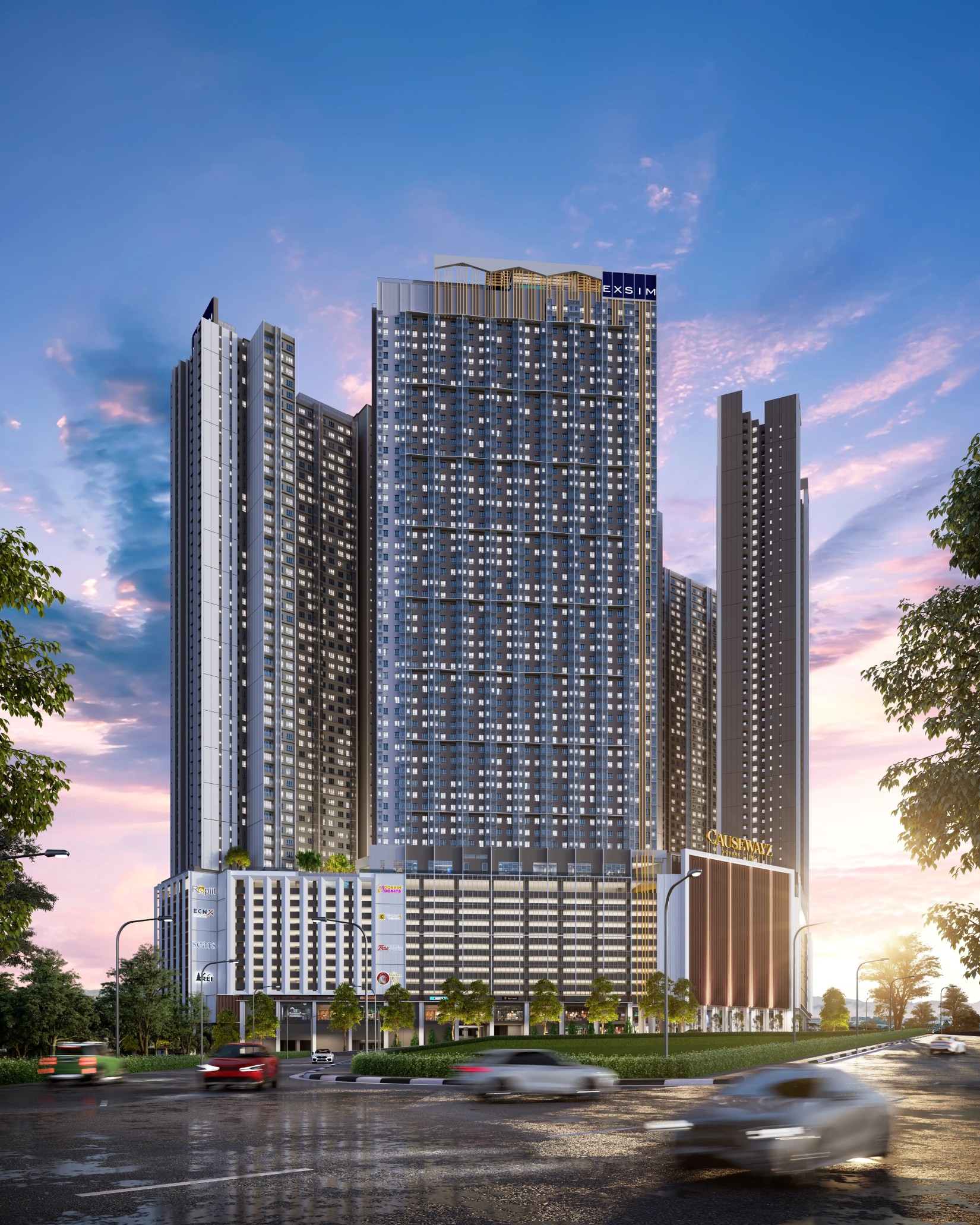
| City centre core | Causewayz Square | JB City Centre, stated at 600 metres from the station | Walking |
| City centre core | Majestics Gen Rise | Johor Bahru CIQ | Walking or short feeder |
| City centre core | R&F Princess Cove | Johor Bahru CIQ | Walking or short feeder |
| City centre core | Aethera Residence | Johor Bahru City Centre | Walking or short feeder |
| Inner Johor Bahru | The Asteriaz by EXSIM | Kebun Teh | Feeder bus or drive |
| Inner Johor Bahru | The Celestz by EXSIM | Kebun Teh | Feeder bus or drive |
| Outer township | Monterra | Tebrau | Depends on the expanded bus network |
| Outer township | Parkland By The River | Permas Jaya | Depends on the expanded bus network |
| Outer township | The Straits View DUO Residence | Permas Jaya | Depends on the expanded bus network |
| Outer township | Meadow Heights | Bandar Tiram | Drive, or bus once routes are confirmed |
You can browse the full set by locality on our Johor Bahru area page, along with Permas Jaya and Ulu Tiram.
What is still unsettled
Three things remain genuinely open, and any marketing that glosses over them is worth treating carefully.
The Elevated Autonomous Rapid Transit project is not signed. The federal government has said it will fund it and Loke has confirmed that any future ART development must integrate with the RTS Link, but the concession agreement is still being negotiated and the financing method, the actual financial commitment and the repayment mechanism have not been announced. ART and RTS are separate projects on separate timelines.
The link bridge is approved but unbuilt, on a twelve-month schedule that starts after the crossing opens.
And the bus operator agreement is not finalised. The 157 buses serving JB Sentral and Bukit Chagar are expected from early 2027, which means the first weeks of RTS operations may run before the feeder network is at full strength.
Why the CIQ is two buildings instead of one
A small detail that has caused some confusion: on the Malaysian side, the CIQ complex and the RTS station were deliberately built as two separate structures, unlike Singapore’s single integrated complex. Loke explained that Singapore’s Public Utilities Board pipelines run between the two buildings and must remain accessible to Singaporean authorities under the bilateral agreement, so the site could not be covered by one structure. It is a design constraint, not a delay or a problem with the works.
Frequently asked questions
When does the RTS Link start operations?
The RTS Link is scheduled to begin operations on 1 January 2027, connecting Bukit Chagar in Johor Bahru with Woodlands North in Singapore. As of August 2026 the station and CIQ structures are physically complete and the project is in its testing and commissioning phase, which involves system integration testing followed by fault-free and trial runs.
How many passengers can the RTS Link carry?
The system is designed to carry up to 10,000 passengers per hour in each direction. Ridership at launch is projected at roughly 40,000 people a day, with longer-term planning figures of about 140,000 a day.
What is the RM60 million bridge at Bukit Chagar?
It is a pedestrian connection between Bukit Chagar RTS station and the KTMB Komuter service, approved by the Ministry of Economy and to be executed by the Ministry of Transport. It will let Komuter passengers walk directly into the RTS station instead of detouring via JB Sentral. It is expected to take about 12 months to build, so it will not be ready when the RTS Link opens.
Which Johor Bahru areas are within walking distance of the RTS station?
Developments in the Johor Bahru city centre and the CIQ vicinity are the ones close enough to walk. Causewayz Square, for example, is stated at 600 metres from the RTS Link station. Addresses in Kebun Teh sit in inner Johor Bahru and would typically need a short feeder trip, while Tebrau, Permas Jaya and Bandar Tiram are outer townships that will depend on the expanded bus network.
Will there be bus connections to Bukit Chagar station?
Yes. The BAS.MY network is being expanded to 28 routes with 254 buses including electric buses, and 157 of those buses are allocated to routes serving JB Sentral and Bukit Chagar, with service expected from early 2027. The agreement with the operator is still being finalised and the final award requires Ministry of Finance approval.
Is the Johor Bahru ART project confirmed?
Not yet. The federal government has said it will fund the Elevated Autonomous Rapid Transit project and has confirmed it must integrate with the RTS Link, but the concession agreement is still being negotiated. The financing method, the financial commitment and the repayment mechanism have not been announced. ART and the RTS Link are separate projects.
Comparing actual projects along the corridor? See the Johor new launch comparison — all 33 current projects side by side.